
What’s going on here?
Thursday (May 30, 2019) was a notable date in African economic history as the day the African Continental Free Trade Area (AfCFTA) came into effect.
What does that mean?
AfCFTA is predicted to:
- “bring $3.6 billion in welfare gains to the continent through a boost in production and cheaper goods” (UNCTAD) from reducing intra-African tariffs;
- raise intra-African trade by 15% to 25%, or $50 billion to $70 billion, by 2040;
- give Africa a combined consumer and business spending of $6.7 trillion in 2030.
What are the issues?
The devil will be the complicated negotiations for implementation (easier said than done), including:
- Understanding how “most favored nation” (MFN) deals get worked out between all the countries;
- The “rules of origin” issue which decides which products get the preferential tariffs depending on its classification;
- Additional complexity to existing agreements across regional bodies (like ECOWAS in West Africa or EAC in East Africa).
While many of the trade discussions are often about moving goods, exports of African services grew more than six times faster than merchandise exports between 1998 and 2015.
How are people reacting?
The implementation of an agreement like AfCFTA requires not just the governments but crucially the input of African businesses and everyday Africans.
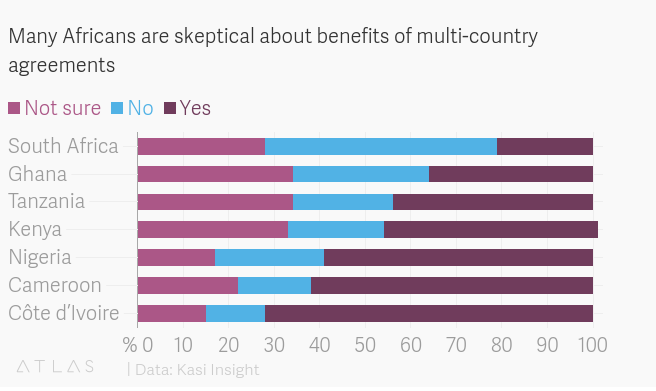
Source: Yinka Adegoke, Editor at Quartz, Quartz
- Respondents weren’t so much skeptical about AfCFTA in benefiting from multi-country agreements;
- Those who understood how the EU works were much more positive about the potential of AfCFTA.
Content source: Adegoke. Y. (2019) So we have an African free trade agreement. Now what?. Quartz Africa. [Online] Available from: https://qz.com/africa/1633022/ [Accessed 2 June 2019]
 with HT